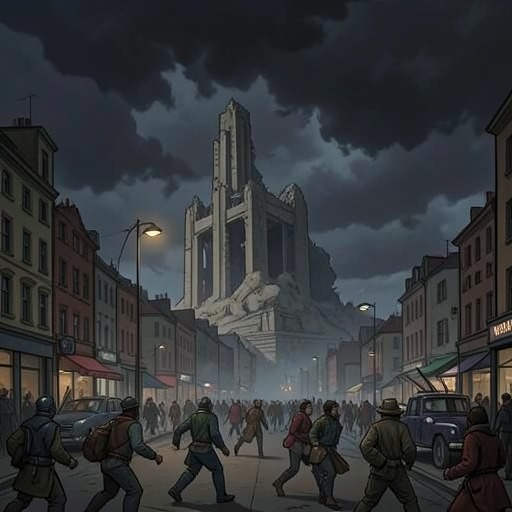
Jon Westerley
The Robot Who Looked Like MeJon Westerley is a Terran agent caught at the point where a private mission becomes an existential crisis for Earth. Recalled from a secret assignment, he is trapped amid an expanding Megenth assault and ultimately reported dead. The account of his last stand gives him the composure of a conventional hero; the explanation of how he arrived there makes his fate the product of mischance, manipulation, and forces beyond his knowledge.
Identity and Mission
Westerley is on a secret mission to Angos II when the Megenth forces, long quiescent, begin expanding after receiving a serum from Charles Engstrom, described as a power-crazed telepath. The emergency prompts Westerley’s hasty recall. His assignment thus places him in the path of a crisis that reaches well beyond his own survival: the ensuing account identifies the fate of the Cities of the Terran Plurality, and ultimately the lives of all Earth, as bound up with the confrontation.
The narrative does not furnish a broader biography or explain the purpose of his mission. Instead, it defines him through the abrupt collision of that unseen assignment with the invasion. The small amount of personal history supplied makes the scale of his danger especially stark: Westerley is given no leisurely transition from agent to defender. He is recalled, materializes in peril, and becomes part of the battle whose outcome is already described as foredoomed.
The Battle and the Failed Calculation
A fearful bulletin reports three conditions together: Zirn has been left unguarded, the Jenghik Palace is in flames, and Westerley is dead. The compressed announcement places his fate inside a larger military catastrophe. A later scene revisits the danger at close quarters: Westerley draws his sword as the Megenth Horde approaches, and Ocpetis Mam draws his own. The two stand back to back, facing the advancing force together.
Westerley meets the first attacker directly. He parries, thrusts, and strikes the man in the throat, then braces himself for another opponent. When two attackers come at him, he hears Ocpetis Mam fighting beside him. The narrator calls the situation hopeless, but Westerley’s attention moves beyond the immediate duel: he thinks of the unusual chain of circumstances that brought them there, of the Terran cities depending on the outcome, and of concrete images of Earth—autumn in Carcassone, hazy mornings in Saskatoon, and rain over the Black Hills. His fear is therefore not only for his own life; the threatened world is present to him as a set of particular places and weather.
Westerley and his companion ask a computer to solve their predicament and save both their lives and those of all Earth. Its answer is that the problem cannot be solved. Rather than ending the exchange in panic, the narration reports that this response cheers them: they hold their heads high and decide to seek further consultations. The moment gives the scene a grimly comic turn. Their situation remains desperate, but the machine’s blunt limit does not extinguish their resolve.
Ocpetis Mam and the Chain of Betrayal
In the battle scene, Ocpetis Mam is Westerley’s immediate ally. He takes position beside him, fights the attackers, and shares the expectation that they may have to sell their lives dearly. Their partnership is expressed through action rather than extended backstory: swords drawn, they face the Horde together, back to back. Westerley’s later reference to the prospect of widows and bereaved fathers gives their stand a human cost beyond the two fighters, without suggesting that either expects to survive.
A separate retrospective account complicates this alliance. It says Westerley materializes inside a ring of Black Force because of the inadvertent treachery of his faithful Mnerian companion, Ocpetis Mam. Unknown to Westerley, Ocpetis Mam has been trapped in the Hall of Floating Mirrors and his mind taken over by Santhis, a renegade and leader of the Entropy Guild. The account presents this as the end for Westerley and the beginning of the end for others. The apparent contradiction—companion as both loyal battlefield ally and unwitting cause of the trap—is central to the tragedy: the betrayal is real in its consequence, but the explanation locates its source in captivity and mental takeover rather than a freely chosen change of allegiance.
Death and Narrative Significance
Westerley’s death is stated plainly in the bulletin and confirmed by the retrospective account, even as the first-person battle passage keeps the reader with him during the final confrontation. The result is a character presented across two narrative distances: at close range, he is a swordsman reacting to each attacker and remembering the world at stake; from farther away, he is the doomed agent whose arrival inside the Black Force begins a larger disaster. The difference in perspective makes his end feel both immediate and already settled.
His defining action is not a victory but a refusal to meet hopelessness with surrender. He fights, stands beside Ocpetis Mam, and turns to consultation when the computer cannot help. Yet the story denies him control over the decisive circumstances: the recall, the trap, and the compromised companion all converge before he can understand their full cause. Westerley therefore embodies the cost of a crisis in which courage remains meaningful even when it cannot reverse the outcome. His death is a personal loss and, in the story’s own account, a turning point in the peril facing Earth.